Views: 0 Author: Site Editor Publish Time: 2026-10-08 Origin: Site


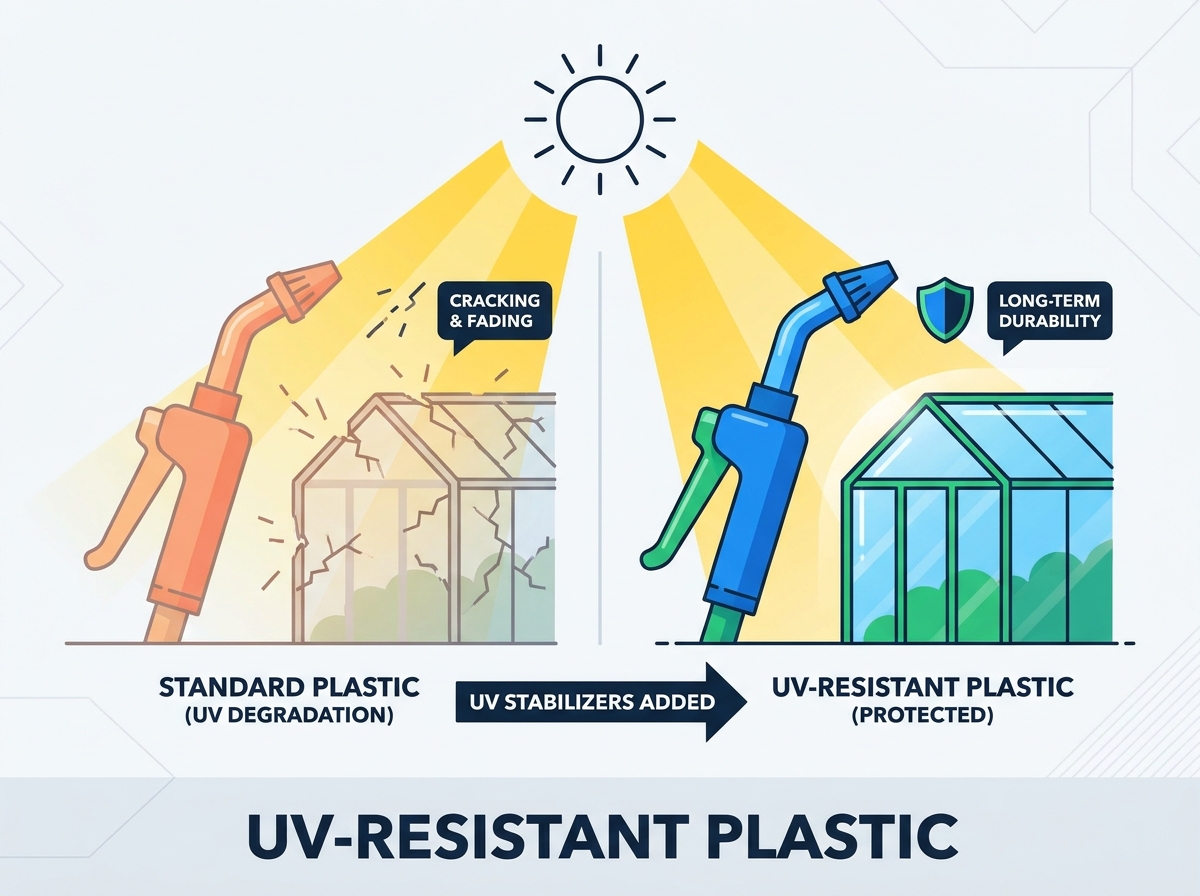
Agricultural machinery operates under prolonged sunlight, changing temperatures, vibration, and exposure to fertilizers and pesticides. These conditions can accelerate plastic aging, causing color fading, surface cracking, reduced impact strength, and premature component failure.
Choosing the right UV resistant plastic helps equipment manufacturers improve outdoor durability and reduce maintenance risks. However, UV resistance alone does not determine material suitability. Engineers must also consider impact strength, chemical compatibility, heat resistance, color requirements, and manufacturing processes.
This guide compares common UV-resistant plastics, explains stabilization methods, and outlines practical selection criteria for agricultural machinery components.
Key Takeaways
Material selection: ASA and weather-resistant AES are potential choices for exposed housings and exterior parts. HDPE and stabilized polycarbonate may suit other applications.
UV protection: Polymer structure, pigments, UV absorbers, and hindered amine light stabilizers (HALS) can influence weathering performance.
Application requirements: Impact resistance, agrochemical exposure, temperature changes, and optical or signal requirements should be evaluated together.
Performance verification: Use grade-specific technical data and weathering tests to validate material performance under expected service conditions.
Table of Contents
Sunlight contains ultraviolet radiation that can initiate chemical reactions in susceptible polymers. These reactions may break polymer chains or cause additional cross-linking, depending on the material and its formulation.
When oxygen participates in the degradation process, photo-oxidation can accelerate material aging. Heat, moisture, mechanical stress, and chemical exposure may further affect the rate of deterioration.
The effects vary by polymer type, pigment, stabilizer package, part design, and outdoor exposure conditions. Therefore, engineers should evaluate the complete compound rather than relying on the base resin name alone.
UV-related aging can appear in several ways:
Color fading: Exterior parts lose their original color or develop uneven discoloration.
Surface chalking: A powdery residue may develop as the surface deteriorates.
Cracking and crazing: Fine cracks may form, particularly in stressed areas.
Reduced impact strength: Components become more likely to crack under impact.
Dimensional or mechanical changes: Long-term weathering may affect stiffness, toughness, and component reliability.
These changes can affect tractor covers, agricultural equipment housings, sensor enclosures, and other exposed components. Their actual severity depends on the material formulation and operating environment.
Premature plastic failure can lead to replacement costs, equipment downtime, warranty claims, and dissatisfied customers. During planting and harvesting, even a relatively small component failure can interrupt an important operation.
Selecting suitable UV-resistant plastic during product development helps manufacturers balance material costs with durability requirements. Weathering performance should be considered alongside mechanical testing and the expected service environment.
Some polymers provide better natural weatherability than others. Their chemical structures can make them suitable for outdoor applications, although their performance still depends on the specific grade and exposure conditions.
Acrylonitrile Styrene Acrylate (ASA) is commonly selected for visible exterior components because of its weatherability and color retention. It can also offer the processing flexibility needed for injection-molded housings and covers.
Acrylonitrile Ethylene Styrene (AES) is another option for selected outdoor equipment and machinery components. Grade-specific impact strength, thermal performance, and weathering data should be checked before final selection.
For projects requiring weather-resistant plastic compounds, manufacturers can review XINYITE's ASA compound solutions and assess suitable grades against the component's performance requirements.
UV absorbers help protect susceptible polymers by absorbing certain wavelengths of ultraviolet radiation and dissipating the absorbed energy through other processes.
Their effectiveness depends on the additive chemistry, concentration, polymer compatibility, and exposure conditions. UV absorbers may be used alone or with other stabilization methods when the formulation requires additional protection.
HALS help interrupt photo-oxidative degradation by neutralizing reactive radicals involved in polymer aging. Unlike conventional UV absorbers, they primarily work through a chemical stabilization mechanism rather than simply absorbing incoming UV radiation.
HALS can be useful in weather-resistant formulations where maintaining mechanical performance and appearance is important. The suitable additive package depends on the base polymer, pigment, processing conditions, and intended service life.
Pigments can influence how a plastic compound interacts with sunlight.
Carbon black provides effective UV screening in many outdoor plastic formulations and is widely used where black or dark-colored parts are acceptable. However, its performance depends on factors such as concentration, dispersion, particle characteristics, and the base polymer.
Titanium dioxide (TiO₂) is commonly used in white and light-colored plastics. Its protective effect depends on the grade, surface treatment, concentration, and formulation. It should not be assumed that every TiO₂ formulation provides the same level of UV protection.
UV protection can be incorporated into the resin or applied to the component surface.
Approach | Main Advantage | Key Consideration |
|---|---|---|
Bulk stabilization | Protection can remain throughout the part thickness | Requires a suitable resin and additive formulation |
Surface coating | Can protect the exposed surface while maintaining optical or decorative properties | Scratches, abrasion, and coating damage may reduce protection |
Co-extruded protective layer | Provides a dedicated weather-resistant outer layer | Layer compatibility, thickness, and processing must be validated |
For agricultural components exposed to abrasion or frequent handling, the choice should account for how the part wears during service.
The best material depends on the component's function, exposure conditions, and manufacturing process. The following comparison provides a starting point for material evaluation.
ASA is a strong candidate for exterior parts that require weatherability and color retention. Potential applications include equipment covers, exterior housings, decorative panels, and other visible components.
Compared with standard ABS, ASA generally offers better outdoor weatherability. It can be considered when a component must retain its appearance under sunlight while supporting conventional thermoplastic processing.
However, UV resistance does not automatically guarantee suitability for every high-impact or high-temperature application. Engineers should verify impact strength, heat performance, color stability, and processing requirements for the selected grade.
Explore XINYITE ASA Compound for product information and material selection support.
Weather-resistant AES can be considered for selected outdoor equipment housings and agricultural machinery components. Its suitability depends on the balance of weatherability, impact performance, rigidity, and processing requirements.
AES may be worth evaluating when manufacturers need an alternative to standard indoor plastics for sunlight-exposed parts. The final choice should be supported by the product's technical data and testing under representative service conditions.
See XINYITE's anti-UV weather-resistant AES material, which lists outdoor equipment and agricultural machine parts among its applications.

HDPE is widely used in containers, fluid-handling systems, and agricultural infrastructure because of its chemical resistance and toughness.
For prolonged outdoor exposure, HDPE generally needs an appropriate UV stabilization package. Carbon-black-stabilized grades are commonly considered for opaque parts, while other formulations may be needed when color or visibility requirements restrict pigment choices.
For chemical tanks and fluid-handling components, engineers should evaluate both the stored chemicals and the effects of long-term weathering. A grade that resists sunlight may still be unsuitable for a particular chemical or operating temperature.
Polycarbonate offers high impact resistance and optical clarity, making it useful for protective glazing, transparent guards, and selected equipment enclosures.
However, unprotected PC can yellow or lose properties under prolonged UV exposure. UV-stabilized grades, protective coatings, or co-extruded UV-resistant layers may be required, depending on the application.
For transparent parts, evaluate UV protection alongside light transmission, abrasion resistance, impact requirements, and the expected cleaning process.
PMMA/ASA compounds combine properties from two polymers and may be considered for outdoor components where weatherability, surface appearance, and impact performance must be balanced.
The performance of a blend depends on its formulation and intended application. It should not be assumed to provide the same optical clarity or impact strength as every pure PMMA or polycarbonate grade.
Review XINYITE's UV-resistant black PMMA/ASA plastic granules for an example of its weather-resistant compound range.
Material | Potential Applications | UV Protection Approach | Main Selection Consideration |
|---|---|---|---|
ASA | Exterior covers, housings, visible panels | Weather-resistant polymer formulation | Color retention, impact strength, and processing |
AES | Outdoor equipment and machinery parts | Weather-resistant formulation | Grade-specific mechanical and weathering data |
HDPE | Tanks, containers, fluid-handling parts | Suitable UV stabilizers and pigments | Chemical compatibility and outdoor exposure |
Polycarbonate | Transparent guards and protective glazing | UV-stabilized grades or protective layers | Impact resistance, clarity, and coating durability |
PMMA/ASA | Selected visible outdoor components | Weather-resistant blend formulation | Appearance, toughness, and application requirements |
PVC | Irrigation pipes, hoses, and fluid transport | Suitable stabilizers and formulation | Flexibility, chemical resistance, and service conditions |
These are general material-selection directions, not universal specifications. Confirm the properties of the exact grade before approving it for production.

Agricultural machinery experiences vibration, impacts, dust, and contact with crops or debris. A plastic component must maintain adequate mechanical performance after outdoor exposure.
Review tensile strength, flexural properties, impact strength, elongation, and stiffness as appropriate to the part. Testing should reflect the actual temperature and aging conditions whenever possible.
Do not select a compound based on UV performance alone. A material that resists fading may still fail if it lacks the required impact strength or fatigue resistance.
Agricultural components may encounter fertilizers, herbicides, pesticides, cleaning agents, hydraulic fluids, and fuels.
Chemical resistance varies by polymer, formulation, concentration, temperature, and exposure duration. Some combinations may cause swelling, stress cracking, discoloration, or loss of mechanical performance.
Check chemical resistance data for the actual operating environment. When failure would be costly, validate the material using representative chemicals and molded samples.
Outdoor parts may experience direct sunlight, high surface temperatures, rain, humidity, and cold storage conditions. Temperature changes can influence stiffness, impact resistance, dimensional stability, and the rate of aging.
Consider heat deflection temperature, thermal expansion, low-temperature impact performance, and dimensional requirements where relevant. These properties should be evaluated alongside UV weathering data rather than treated as separate concerns.
Modern agricultural machinery uses GPS, telemetry, radar, and other sensing technologies. The material surrounding an electronic component must protect it from environmental exposure without compromising the required signal performance.
Conductivity, dielectric properties, pigments, fillers, wall thickness, and the antenna design can all affect signal transmission. Do not assume that a polymer is automatically RF-transparent because it is non-metallic.
Confirm the required operating frequencies and validate the complete housing design with the sensor or electronics supplier.
Visible exterior components often need consistent color and gloss throughout their service life. The pigment and stabilizer package can influence both initial appearance and long-term weatherability.
ASA and suitable PMMA/ASA formulations may be worth evaluating for color-critical outdoor parts. The final choice should consider color matching, impact requirements, cost, and weathering-test results.
Replacing selected metal components with engineered plastics can reduce part weight, simplify complex shapes, and combine multiple components into one molded part. Plastics can also resist corrosion in environments where metals require protective treatments.
However, the benefits depend on the application. Metals may remain preferable for components exposed to high loads, severe heat, or demanding structural conditions.
Before replacing a metal part, assess:
Load-bearing requirements and safety factors.
Long-term creep, fatigue, and vibration.
UV exposure and chemical contact.
Fastening points, wall thickness, and dimensional stability.
Tooling investment, production volume, and total part cost.
A material substitution should be validated through engineering analysis and prototype testing rather than based on weight or resin price alone.
Accelerated weathering tests can help compare material performance under controlled exposure conditions. Depending on the project, engineers may consider ASTM G154 for fluorescent UV exposure or ASTM G155 for xenon-arc exposure.
Test selection should reflect the material, exposure environment, and failure modes of concern. Accelerated results do not automatically translate into an exact number of outdoor service years.
Record changes in color, surface appearance, impact strength, tensile properties, and other application-specific criteria. Compare aged samples with unexposed controls.
Material performance depends on resin grade, additives, pigment dispersion, processing, and quality control. Changes in any of these factors can affect the final component.
When evaluating a supplier, request:
A grade-specific technical data sheet.
Relevant UV or weathering test results.
Mechanical and thermal property data.
Chemical compatibility information where needed.
Processing recommendations and batch quality documentation.
Samples for molding trials and application testing.
For custom compounds, communicate the component design, exposure conditions, target properties, color requirements, and manufacturing method before finalizing the formulation.
Selecting a UV resistant plastic for agricultural machinery requires balancing weatherability with mechanical strength, chemical compatibility, temperature performance, appearance, and processing needs.
ASA and weather-resistant AES may suit selected exterior housings and machinery parts. HDPE may be appropriate for fluid-handling applications, while UV-protected polycarbonate can be considered for impact-resistant transparent components. The right choice depends on the exact grade and application.
Before production, review technical data, validate the material under representative conditions, and confirm that the compound meets the component's performance requirements.
For manufacturers evaluating weather-resistant plastic compounds, XINYITE's ASA materials and AES materials for outdoor equipment provide relevant starting points for further technical discussion.
Contact the supplier with your application, processing method, exposure conditions, and target properties to identify suitable material options.
There is no single best material for every component. ASA and weather-resistant AES may suit outdoor housings and covers, while stabilized HDPE may be suitable for tanks. UV-protected polycarbonate can be considered for transparent guards. The final choice depends on mechanical, chemical, thermal, and weathering requirements.
ASA generally offers better weatherability and color retention than standard ABS, making it a candidate for outdoor components. Performance still depends on the grade, formulation, processing conditions, and exposure environment.
Carbon black absorbs and screens UV radiation within many polymer formulations, reducing the amount that reaches susceptible polymer chains. Its effectiveness depends on the carbon black grade, concentration, dispersion, and base resin.
Manufacturers can use suitable accelerated weathering methods, such as ASTM G154 or ASTM G155, alongside mechanical and appearance testing. The test conditions should reflect the intended application, and accelerated exposure should not be treated as a direct prediction of outdoor service life.
Compare grade-specific technical data, relevant weathering results, mechanical properties, chemical compatibility, processing guidance, and quality documentation. Provide the supplier with the component's application, production process, target properties, and expected outdoor conditions before requesting a recommendation.