Views: 0 Author: Site Editor Publish Time: 2026-10-12 Origin: Site


Choosing the right power tool housing material affects impact resistance, structural rigidity, heat performance, dimensional stability, and manufacturing cost. Power tool housings must protect internal components from mechanical loads, vibration, temperature changes, and everyday handling.
Three materials often considered for molded housings are PC/ABS, glass fiber reinforced PA6, and glass fiber reinforced PA66. Each offers a different balance of performance and processing requirements. The best option depends on the tool design, operating environment, safety requirements, and target production cost.
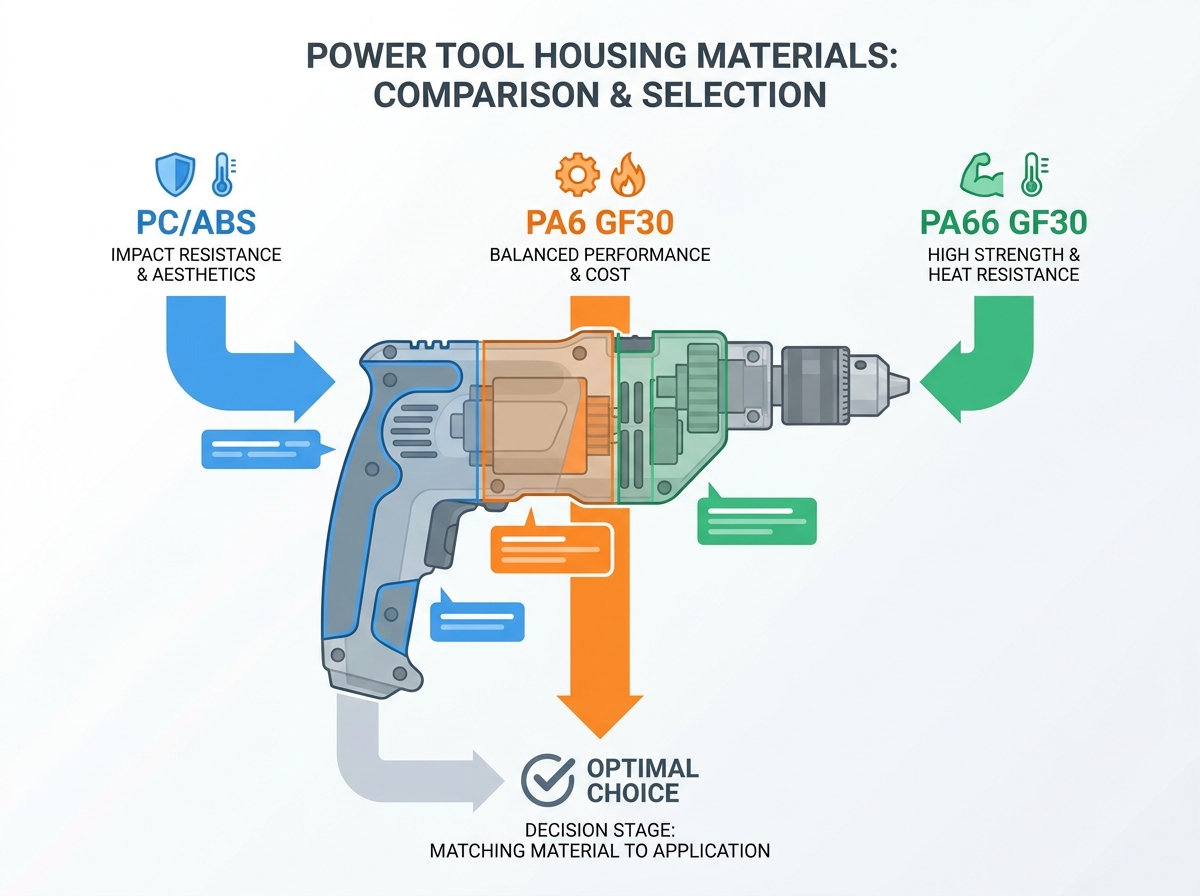
PC/ABS is worth considering when impact performance, surface finish, and dimensional stability are important.
PA6 GF30 offers a balance of stiffness and mechanical performance for many structural components.
PA66 GF30 is worth evaluating when higher stiffness and heat resistance are priorities.
Glass fiber reinforcement can improve mechanical properties but may increase mold wear and affect part warpage.
Final selection should be based on grade-specific technical data sheets (TDS), part design, and validation testing.
Table of Contents
Power tools may experience accidental drops, vibration, and repeated mechanical loads. The housing must withstand these conditions without unacceptable cracking or deformation.
Notched impact strength helps engineers evaluate how a material responds to stress concentrations. Corners, ribs, screw bosses, and weld lines can become weak points in a molded part. Material performance therefore depends on both resin selection and component design.
For reliable evaluation, test representative molded parts under the conditions relevant to the finished tool. Do not assume that a resin's published impact value guarantees that every housing design will pass a drop test.
Motors, gearboxes, and battery systems can expose nearby components to elevated temperatures. A housing must maintain sufficient stiffness and dimensional stability under its expected operating conditions.
Heat deflection temperature (HDT) provides a useful comparison point, but it does not represent a universal maximum service temperature. Engineers should check the test load, test method, continuous-use requirements, and actual temperature profile of the application.
Dimensional changes can affect screw fittings, bearing seats, snap-fits, and assembly tolerances. PC/ABS generally absorbs less moisture than standard polyamides, while PA6 and PA66 can absorb moisture from the surrounding environment.
Moisture can change nylon's stiffness, toughness, and dimensions. Designers should account for the expected moisture condition instead of relying only on measurements taken immediately after molding.
Glass fiber reinforcement can improve stiffness and strength, but the fibers are abrasive. Mold design, tool steel, gate location, cooling, and maintenance should therefore be considered during material selection.
Fiber orientation can also cause different shrinkage rates in different directions. This may contribute to warpage or dimensional variation. Mold-flow analysis and prototype testing can help identify these risks before mass production.
PC/ABS combines polycarbonate and ABS to balance impact performance, heat resistance, and processability. Depending on the grade, it can provide a good surface finish and useful dimensional stability for molded enclosures.
Compared with glass-filled nylon, unfilled PC/ABS avoids the additional abrasive wear associated with glass fibers. This can simplify tooling considerations when appearance and production consistency are priorities.
However, PC/ABS is not automatically suitable for every chemical, temperature, or structural load. Compatibility depends on the formulation and exposure conditions. Solvents, oils, cleaning agents, and sustained stress should be evaluated using the specific grade.
Flame retardancy is also grade-dependent. Do not assume that every PC/ABS compound meets UL 94 V-0. Confirm the rating, specimen thickness, and supporting documentation for the selected product.
For related material options, see Xinyite's flame-retardant PC/ABS alloy.
PA6 GF30 is polyamide 6 reinforced with 30% glass fiber. The reinforcement increases stiffness and strength compared with unfilled PA6, making the material worth considering for structural molded components.
Its suitability for a power tool housing depends on the required impact performance, part geometry, moisture condition, and operating temperature. A well-designed part can benefit from glass fiber reinforcement, but high stiffness alone does not guarantee drop-test performance.
PA6 absorbs moisture from the environment. This can increase toughness while reducing stiffness and changing dimensions. Engineers should consider the expected service environment and define appropriate conditioning and inspection procedures.
Glass-filled nylon can also support designs that combine rigid structural sections with softer grip materials. Where overmolding is used, compatibility between the nylon grade and the selected elastomer should be verified through testing.

Explore Xinyite's PA6 GF30 glass fiber reinforced nylon for product details and grade-specific technical information.
PA66 GF30 is polyamide 66 reinforced with 30% glass fiber. It is commonly evaluated for components that need high stiffness, mechanical strength, and heat resistance.
Compared with PA6 GF30, PA66 GF30 often offers advantages in stiffness and thermal performance. The actual difference depends on the specific formulations and test conditions. Engineers should compare grade-level TDS data rather than treating the material names as complete performance specifications.
PA66 GF30 can be a candidate for housings or internal structural parts near heat-generating components. However, its impact performance must also be checked, particularly when the finished tool may be dropped or exposed to repeated shocks.
Glass fiber orientation, weld-line position, wall thickness, and molding conditions can all affect the strength of the finished part. Appropriate mold design and physical testing remain essential.

See Xinyite's PA66 GF30 glass fiber reinforced nylon for product specifications and material information.
Selection factor | PC/ABS | PA6 GF30 | PA66 GF30 |
|---|---|---|---|
Main advantage | Impact performance and surface finish, depending on grade | Balance of stiffness and mechanical performance | Stiffness and heat performance |
Glass fiber | Usually unfilled in this comparison | 30% | 30% |
Moisture response | Generally lower than polyamides | Moisture absorption can affect properties and dimensions | Moisture absorption can affect properties and dimensions |
Tooling considerations | No glass-fiber abrasion in unfilled grades | Glass fibers can increase mold wear | Glass fibers can increase mold wear |
Key checks | Chemical compatibility, heat performance, flame rating | Impact strength, moisture condition, warpage | Impact strength, heat performance, weld lines |
Typical selection approach | Enclosures where appearance and impact performance matter | Structural parts requiring a balance of properties | Structural parts requiring higher stiffness or heat performance |
This table is a general screening guide, not a substitute for comparing specific grades under the same test methods and conditioning conditions.
Glass fibers can orient along the direction of melt flow. This can cause different shrinkage rates in different directions and may lead to warpage.
Engineers can reduce risk by reviewing gate locations, wall thickness, cooling balance, and mold-flow results. Prototype measurements should confirm that the part meets assembly tolerances.
Weld lines form where separate melt fronts meet. In glass-filled compounds, fiber orientation around these areas may reduce local mechanical performance.
Gate placement and process optimization can help move weld lines away from highly stressed areas. Physical testing should focus on features such as screw bosses, handles, ribs, and mounting points.
Polyamides may change properties as they absorb moisture. Material drying before molding and conditioning after molding serve different purposes and should follow the selected resin supplier's recommendations.
Use the correct material handling procedures and record conditioning conditions when comparing test results. Do not apply one conditioning protocol to every nylon grade without verification.
Glass-filled materials can increase wear on screws, barrels, and mold surfaces. The extent depends on fiber content, equipment, processing conditions, and production volume.
Tooling materials and maintenance plans should reflect the selected compound. Mold temperature and filling conditions should also be optimized to control surface defects and dimensional variation.
Define the operating conditions. Record expected impact, vibration, temperature, chemical exposure, and dimensional requirements.
Compare grade-specific TDS data. Review tensile strength, impact strength, HDT, shrinkage, moisture absorption, and any required flame-retardancy ratings.
Review the part and mold design. Check wall thickness, ribs, screw bosses, gate positions, and likely weld-line locations.
Mold and inspect prototypes. Measure critical dimensions and examine surface quality and assembly fit.
Test under representative conditions. Conduct impact, thermal, chemical-compatibility, and durability tests as required by the application.
Confirm applicable safety standards. Use the current standard and test method for the specific tool category and target market.
There is no single best power tool housing material for every application. PC/ABS can be suitable when impact performance, appearance, and lower glass-fiber-related tooling wear are important. PA6 GF30 offers a balance of stiffness and mechanical performance, while PA66 GF30 is worth evaluating when higher stiffness and heat performance are priorities.
The final choice should reflect the complete part design, service environment, molding process, and cost target. Compare technical data sheets from the actual grades, then validate the molded component under representative conditions.
For material selection support, explore Xinyite's PA6 GF30, PA66 GF30, and flame-retardant PC/ABS product pages.
The best choice depends on impact requirements, heat exposure, stiffness, dimensional tolerances, chemical contact, and cost. PC/ABS, PA6 GF30, and PA66 GF30 should be compared using grade-specific data and molded-part testing.
Both contain 30% glass fiber. PA66 GF30 often provides higher stiffness and heat performance, while PA6 GF30 may offer a useful balance of mechanical properties. Exact performance depends on the formulation and test conditions.
PC/ABS can be suitable when impact performance, appearance, and processability are important. Chemical compatibility, heat performance, structural loads, and flame-retardancy requirements must be checked for the selected grade.
Yes. Glass fibers can increase wear on processing equipment and molds. Fiber orientation can also affect shrinkage, warpage, and weld-line strength. Tooling design and process validation are important.
Define the operating conditions, compare technical data sheets, review mold design, and test molded prototypes. Verify the applicable safety standards and validate performance under conditions representative of the finished tool.