Views: 0 Author: Site Editor Publish Time: 2026-10-27 Origin: Site
Agricultural machinery operates in demanding outdoor environments. Plastic components must withstand sunlight, impact, temperature changes, vibration, and exposure to fertilizers and agricultural chemicals. Choosing the wrong material can lead to premature cracking, deformation, and costly equipment downtime.
Selecting reliable agricultural machinery plastic parts starts with understanding the working conditions of each component. Engineers must evaluate UV resistance, mechanical strength, chemical compatibility, dimensional stability, and manufacturing requirements before choosing a polymer.
This guide compares common engineering plastics and explains how to match material properties to agricultural equipment applications.
Key Takeaways
Match materials to the application: No single polymer suits every agricultural component.
Consider outdoor exposure: UV-stabilized materials are important for parts exposed to prolonged sunlight.
Balance strength and weight: Glass-fiber-reinforced plastics can improve stiffness and dimensional stability.
Check chemical compatibility: Tanks, nozzles, and fluid-handling parts need materials compatible with the actual chemicals they encounter.
Validate performance: Review material data sheets and test finished components under representative operating conditions.
Table of Contents
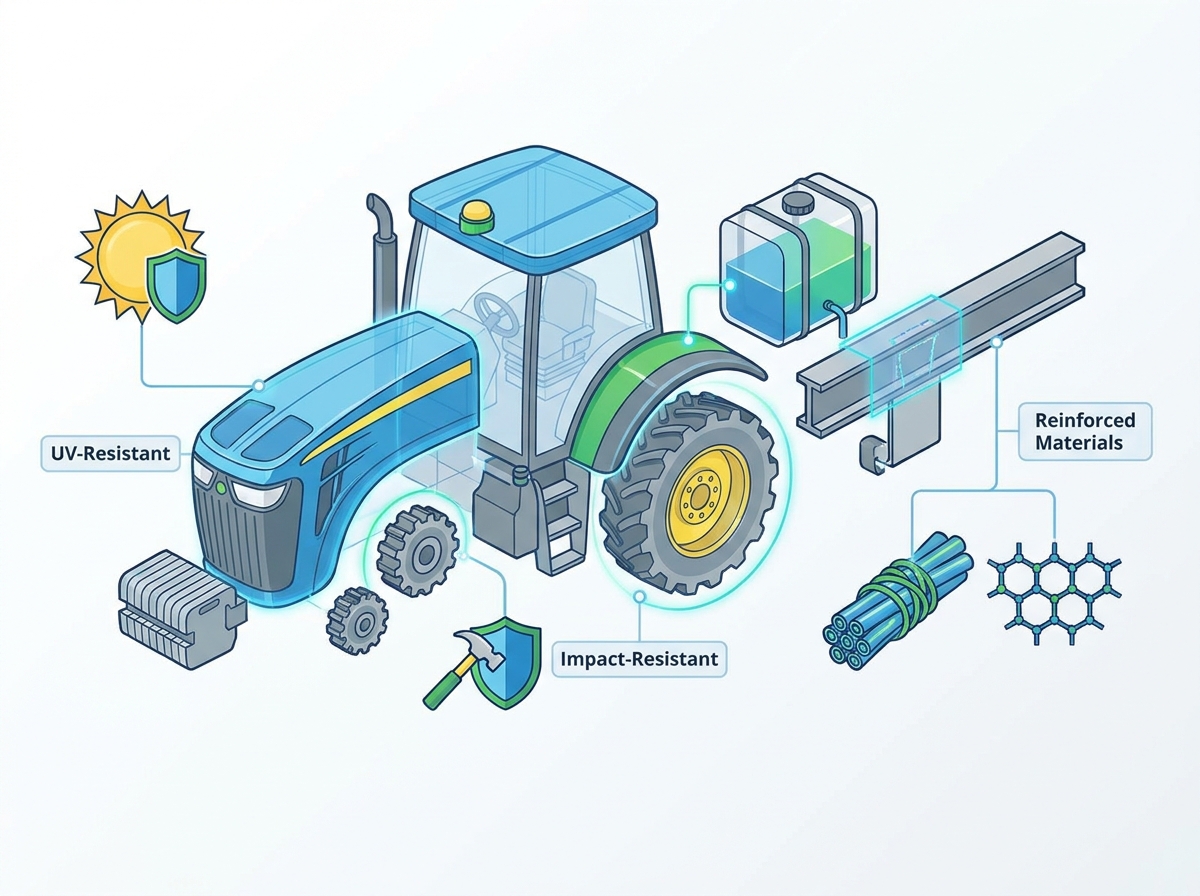
Plastic components exposed to sunlight can gradually lose color, toughness, and mechanical strength. UV radiation and oxidation may cause surface chalking, discoloration, and cracking.
For exterior agricultural machinery plastic parts, consider weather-resistant grades such as AES or ASA. Stabilized formulations of other polymers may also be suitable, depending on the application.
The correct choice depends on exposure duration, operating climate, required service life, and the component's mechanical loads.
Explore Xinyite's weather-resistant AES plastic material for an example of a polymer developed for outdoor equipment and agricultural machinery applications.
Agricultural equipment encounters vibration, sudden impacts, and repeated mechanical stress. Protective covers may be struck by stones or branches, while gears and brackets must withstand ongoing loads.
When comparing materials, review tensile strength, flexural strength, impact resistance, and performance at low temperatures. Test conditions matter because published properties may vary with material grade, specimen preparation, and temperature.
Glass-fiber-reinforced polymers can improve stiffness and strength for structural parts. However, increased reinforcement may reduce elongation or impact performance in some formulations. Select the reinforcement level according to the actual load and failure risks.
Agricultural machinery may contact fertilizers, pesticides, herbicides, hydraulic fluids, lubricants, and fuels. Chemical compatibility varies by polymer, formulation, concentration, temperature, and exposure duration.
For fluid-handling components, evaluate the exact chemicals involved rather than relying on general material descriptions. Also consider environmental stress cracking, which can occur when a stressed plastic part contacts an incompatible chemical.
Polypropylene and polyethylene grades are commonly considered for many chemical-handling applications. The final choice should be confirmed against the chemical supplier's compatibility data and the plastic manufacturer's technical documentation.
Outdoor equipment experiences seasonal temperature changes, hot surfaces, and cold starts. Plastics also expand and contract more than many metals, which can affect fit and assembly.
For large panels and precision components, evaluate the operating temperature range, heat deflection temperature, thermal expansion, and moisture absorption. Design clearances and mounting points to accommodate dimensional changes where necessary.
AES and ASA are worth considering for exterior components that require weatherability, impact performance, and color retention. Potential applications include equipment housings, exterior covers, and visible panels.
Material performance depends on the specific formulation and grade. For demanding outdoor applications, request weathering data and confirm that the selected grade meets the expected exposure conditions.
See Xinyite's weather-resistant AES material, which lists outdoor equipment and agricultural machinery parts among its applications.
Polycarbonate combines high impact resistance with optical clarity. It may be suitable for protective shields, transparent covers, and selected operator-area components.
Standard PC can degrade under prolonged UV exposure. For exterior use, verify whether the selected grade includes suitable UV protection or requires a protective coating.
The design must also account for scratching, cleaning agents, impact requirements, and relevant machinery safety standards.
Polypropylene offers low density, good chemical resistance, and useful fatigue resistance. Depending on the grade, it can be used for tanks, covers, fluid-handling components, and other molded parts.
Its mechanical properties and outdoor durability vary by formulation. For exposed components, confirm the need for UV stabilization and test the material against the chemicals and temperatures expected in service.
Nylon, also known as polyamide, is used in applications that require strength, wear resistance, and mechanical performance. Potential agricultural applications include gears, bushings, brackets, and machinery components.
Glass-fiber reinforcement can improve stiffness, strength, and dimensional stability. However, unreinforced and reinforced grades behave differently. Polyamide can also absorb moisture, which may affect dimensions and mechanical properties.
Compare the available grades in Xinyite's PA6 material range when evaluating nylon for mechanical applications.
Glass-fiber-reinforced polymers can help replace selected metal components where lower weight, corrosion resistance, and molded geometry are valuable.
For example, Xinyite's PA6 GF40 material is a glass-fiber-reinforced nylon grade for applications requiring enhanced strength and rigidity.
Reinforcement percentage alone does not determine suitability. Review impact performance, fiber orientation, moisture effects, molding conditions, and the loads acting on the finished part.
Material | Potential Applications | Main Considerations |
|---|---|---|
AES / ASA | Exterior housings and panels | Weatherability, color retention, impact requirements |
PC | Protective shields and transparent covers | Impact strength, UV protection, optical requirements |
PP | Fluid-handling parts, covers, molded components | Chemical compatibility, UV stabilization, stiffness |
PA6 / PA66 | Gears, bushings, brackets | Strength, wear, moisture absorption |
Glass-fiber-reinforced polymers | Structural brackets and load-bearing components | Stiffness, impact performance, fiber orientation |
Exterior covers need to withstand sunlight, rain, dust, vibration, and occasional impacts. Weather-resistant AES or ASA grades may suit visible housings, while other polymers may be appropriate when chemical or structural requirements take priority.
Check the material's weathering performance, color stability, impact resistance, and compatibility with cleaning products.
Moving components need to resist friction, wear, and repeated loading. Polyamide grades may be appropriate for gears and brackets, while specialized wear-resistant plastics may be better for sliding surfaces.
Evaluate lubrication, operating temperature, load, rotational speed, moisture, and dimensional tolerances before selecting a material.
Tanks, nozzles, and fluid-path components must remain compatible with the fluids they contact. Consider chemical concentration, exposure duration, temperature, pressure, and the manufacturing process.
Do not select a resin based on chemical resistance alone. The finished component must also meet structural, sealing, and service-life requirements.
Transparent components require a balance between visibility, impact resistance, UV durability, and scratch resistance. PC and acrylic offer different combinations of these properties.
Confirm the safety requirements and impact risks before choosing a transparent material. The suitability of a particular polymer depends on the component design and applicable standards.
Injection molding is suitable for many complex parts and higher-volume production. CNC machining may be practical for prototypes, repairs, or lower-volume components. Extrusion and other processes can be appropriate for profiles, sheets, and specialized geometries.
The material and process should be evaluated together. Flow behavior, shrinkage, mold design, fiber orientation, wall thickness, and production volume can all affect cost and finished-part performance.
Plastic parts often expand and contract more than metal frames. Poorly designed mounting points can create stress, warping, or cracking as temperatures change.
For large panels, engineers may need to consider slotted mounting holes, suitable clearances, and fastening methods that allow controlled movement without compromising safety or fit.
Material data sheets provide a starting point, but they cannot predict every field condition. Test prototypes under realistic combinations of UV exposure, temperature, vibration, impact, and chemical contact.
Depending on the application, validation may include:
UV and accelerated weathering tests.
Impact tests at relevant operating temperatures.
Chemical compatibility and environmental stress cracking tests.
Dimensional checks after moisture and temperature conditioning.
Load, fatigue, and field-performance testing.
Use appropriate test methods and acceptance criteria for the actual component. Keep records of the material grade, batch, processing conditions, and test results.
A reliable supplier should help you assess more than the resin's basic name. Before approving a material, consider the following:
Technical documentation: Request current data sheets and test methods for the exact grade.
Application experience: Check whether the supplier understands outdoor equipment and agricultural operating conditions.
Material customization: Ask whether UV stabilization, reinforcement, impact modification, or other formulation adjustments are available.
Batch consistency: Confirm the supplier's quality-control and traceability processes.
Technical support: Discuss material selection, processing requirements, prototype testing, and potential failure modes.
Xinyite provides a range of engineering plastics, including PP, PA, PC, ABS, AES, ASA, and reinforced grades. Visit the Xinyite product range to review available material categories, or explore its agricultural machinery and equipment applications.
Choosing the right agricultural machinery plastic parts requires balancing weatherability, impact strength, chemical compatibility, dimensional stability, and manufacturing cost.
Start by defining the operating conditions and likely failure modes of each component. Then compare suitable polymer grades using technical data, confirm compatibility with the intended process, and validate the design through relevant testing.
Working with an experienced engineering plastics supplier early in the design process can help manufacturers identify suitable materials, reduce avoidable design risks, and develop more reliable agricultural equipment components.
There is no universal best material. AES or ASA may suit weather-exposed housings, PC may suit impact-resistant transparent covers, PP may suit compatible fluid-handling applications, and PA or reinforced polymers may suit mechanical components. The final choice depends on the operating conditions and grade specifications.
Manufacturers can select weather-resistant polymer grades or use suitable UV stabilizers, pigments, or protective coatings. The appropriate approach depends on the base resin, component color, exposure conditions, and required service life.
Glass fibers can increase stiffness, strength, and dimensional stability. Reinforced plastics may replace selected metal parts, but engineers must also evaluate impact performance, moisture effects, fiber orientation, and manufacturing requirements.
PP and certain polyethylene grades are commonly considered for chemical-handling components. Compatibility must be confirmed for the specific chemical, concentration, temperature, and exposure conditions before the material is approved.
Review the component's mechanical loads, UV exposure, temperature range, chemical contact, dimensional tolerances, manufacturing process, and expected service life. Request grade-specific technical data and test prototypes under representative conditions before full-scale production.